
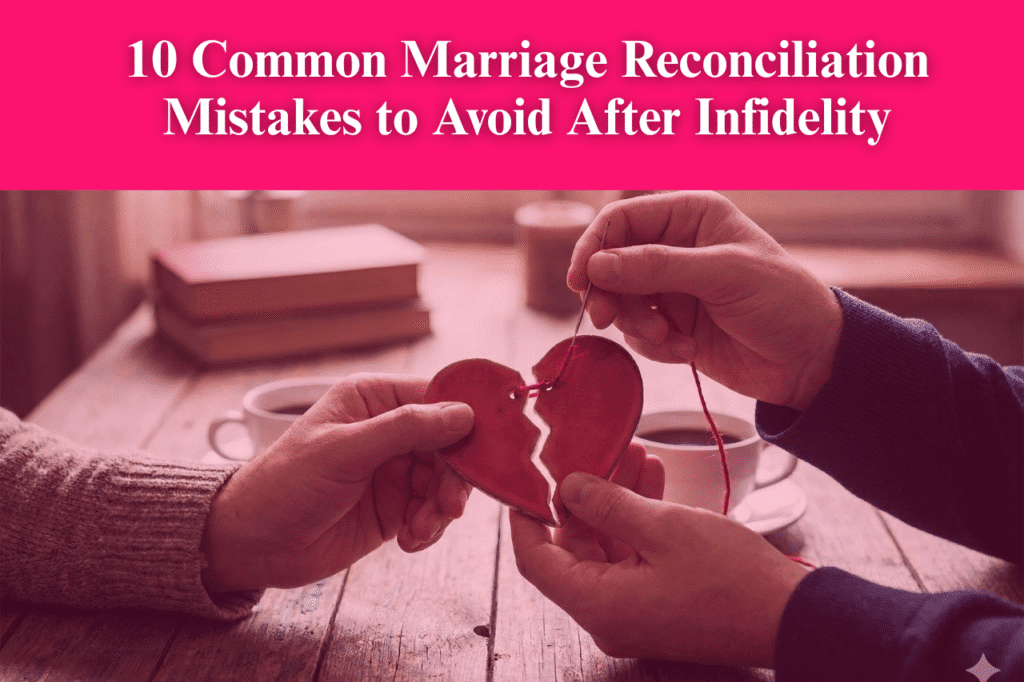
Your world has just been split into a before and after.
The ground beneath your feet is gone, and in its place is a dizzying freefall of questions, pain, and a future that looks like a foreign, hostile country.
You’re desperately searching for a map, for any sign that tells you which way is up.
You’re wondering if it’s even possible to find your way back to each other, if reconciliation after infidelity is a real destination or just a cruel mirage.
You’re trying to figure out how to reconcile after cheating without losing the last shreds of your sanity.
Friend, take a breath. You are not alone in this storm.
The path forward is fragile, and it’s shockingly easy to take a wrong turn when you’re bleeding.
That’s exactly why we need to talk about the 10 common marriage reconciliation mistakes to avoid after infidelity.
Haling is possible, yes, but only if you avoid doing the very things that sabotage it.
Table of Contents
ToggleIs Reconciliation After Infidelity Possible?
The short answer? Yes. The long answer? Yes, but you need to stop thinking about it like fixing a flat tire.
You can’t just patch it up, pump it full of air, and drive off like nothing happened. The old marriage is dead.
I know that sounds dramatic, but it’s true. We have to mourn the old relationship because it didn’t survive the crash.
Reconciliation after infidelity is possible, but it is not a resurrection of what you had. It is a new build.
It is starting from scratch on the same plot of land, but this time you know where the sinkholes are.
Statistically, plenty of couples survive this. Some even end up happier. I know, that sounds insane right now. You probably want to punch anyone who says “this will make you stronger.”
But the couples who make it are the ones who accept that they aren’t “going back” to anything. They are moving forward into something totally different.
Rebuilding after betrayal requires two people who are willing to bleed a little to clean out the wound.
If the cheater is just saying “sorry” to get you to stop crying, it won’t work. If the betrayed partner is only staying because of the kids or rent money, it won’t work.
It only works if you both decide that despite the wreckage, there is something in the rubble worth saving.
Why Reconciliation After Cheating Is Hard for a Couple?
It’s hard because the two of you are currently living in two completely different realities.
The person who cheated usually wants to “fast forward” the movie.
They feel guilty, sure. They feel shame. But mostly, they want the yelling to stop.
They want to stop feeling like the bad guy. They want to sweep the glass under the rug and pretend the floor is clean.
On the other hand, the person who was cheated on is stuck in a time loop.
They are replaying every memory from the last two years, wondering if it was a lie. They are the detective in a crime drama, obsessively looking for clues they missed.
This disconnect creates a massive friction. You want answers; they want silence. You want safety; they want forgiveness.
Navigating reconciliation after cheating is exhausting because you are trying to rebuild trust with the very person who broke it.
It is counter-intuitive. Your brain is screaming “Danger! Run away!” while your heart is saying “But I love them.” You are fighting your own survival instincts.
It is also hard because fairness has left the building.
It feels wildly unfair that the person who caused the wreck gets to sit in the passenger seat while you, the victim, have to drive the car and fix the engine at the same time.
It’s messy. It’s draining. And it takes a level of emotional maturity that most of us simply didn’t have before the bomb went off.
10 Common Marriage Reconciliation Mistakes to Avoid After Infidelity
We need to look at the trap doors. Everyone thinks they won’t fall into them, but emotions make us do stupid things.
When you are hurting, your instincts are usually wrong. You want to scream, control, or run. But if you actually want to save this thing, you have to fight those impulses.
Here are the 10 common marriage reconciliation mistakes to avoid after infidelity that trip up almost everyone.
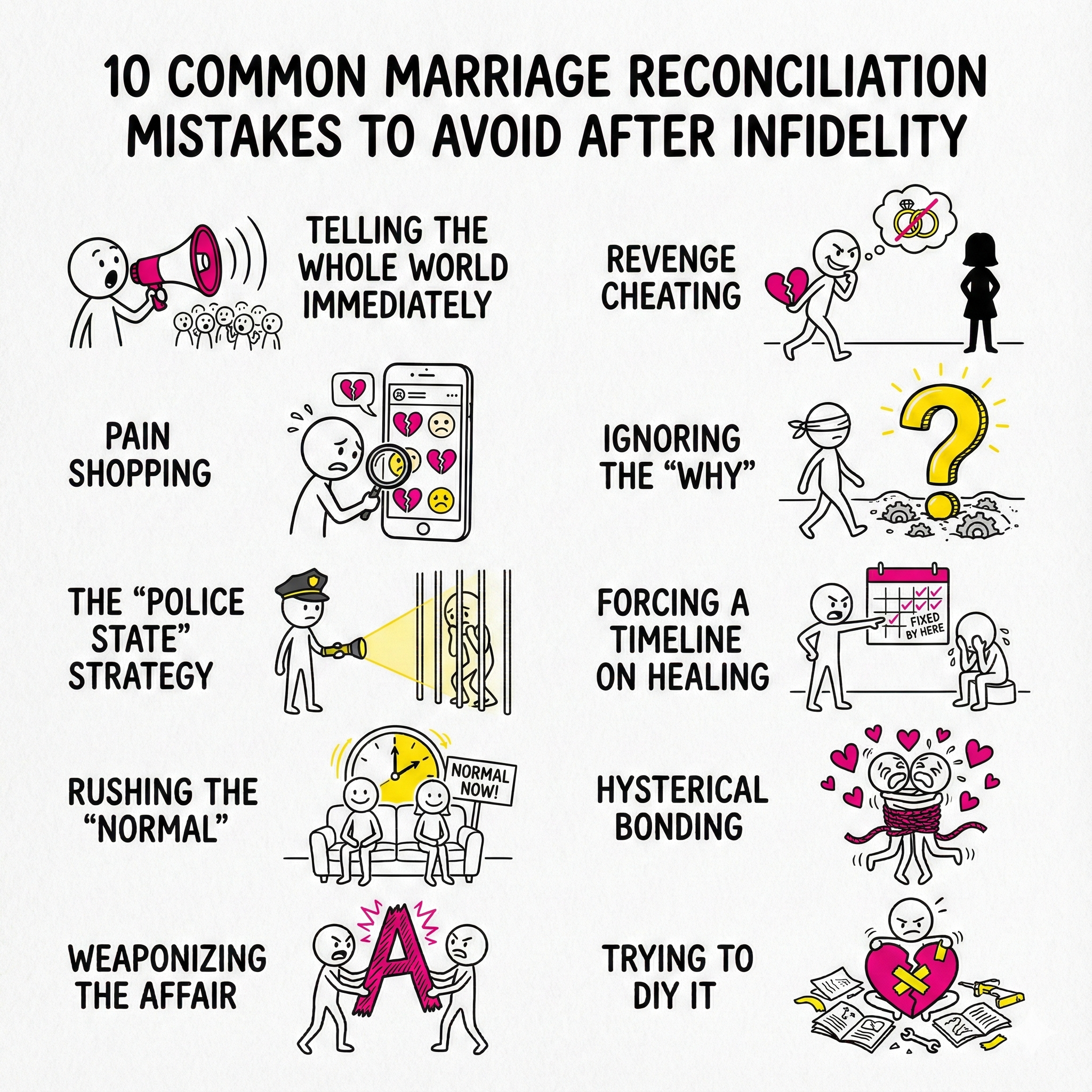
1. Telling the Whole World Immediately
You are furious. You want to shame your partner. So you call your mom, your sister, and maybe you even post a vague, angry quote on Facebook. Stop.
Once you tell your family, they will adopt your anger. But unlike you, they won’t work through it.
If you reconcile, you might forgive your partner, but your dad never will.
You are creating an audience for your marriage problems that you can’t remove later. Keep the circle small.
2. Pain Shopping
This is when you demand details that don’t help you heal.
“Was she better looking? What exactly did you do in the car? Did you tell him you loved him?”
You think you want the truth, but you are actually just cutting yourself to see if you still bleed.
Knowing the graphic details doesn’t protect you. It just creates movies in your head that you won’t be able to turn off.
Get the facts you need to understand the scope of the betrayal, then stop digging.
3. The “Police State” Strategy
Tracking their phone location and checking their mileage every day? You turn the marriage into a warden-prisoner relationship.
Look, transparency is necessary. But surveillance is not safety.
If you have to watch them 24/7 to make sure they aren’t cheating, you aren’t married. You’re a babysitter. You cannot control someone into being faithful.
4. Rushing the “Normal”
The cheater often wants to “get back to normal” in a few weeks. They start acting like everything is fine. This is a disaster.
There is no going back to normal. That normal is gone.
Trying to pretend the elephant isn’t in the room just makes the elephant angry. You have to sit in the uncomfortable mud for a while.
It sucks, but it’s the only way through.
5. Weaponizing the Affair
You get into an argument about who forgot to empty the dishwasher, and suddenly you yell, “Well at least I didn’t sleep with my coworker!”
If you use the affair as a trump card to win every unrelated argument, the relationship will die of resentment.
The affair is a serious issue to be discussed, not a grenade to throw whenever you are annoyed.
6. Revenge Cheating
You want to “level the score.” You want them to feel as small and hurt as you do. So you go out and find a fling.
The math doesn’t work here. Two betrayals don’t equal a balanced marriage. They just equal double the trauma. You won’t feel better; you’ll just feel dirty and complicated.
7. Ignoring the “Why”
This is tricky. The cheater is 100% responsible for the choice to cheat. No excuses.
But, the marriage had a culture before the affair. Was there distance? Resentment? A dead bedroom?
If you just blame the “evil other woman” or “bad impulse” without looking at the cracks in the marriage foundation, you are just waiting for the next collapse.
8. Forcing a Timeline on Healing
“It’s been six months, why are you still bringing this up?”
If the unfaithful partner says this, it shows they don’t get it.
Trauma has no calendar. Healing isn’t a straight line; it’s a spiral.
You will have good weeks and then a trigger will send you back to Day 1. Accept the chaos of the timeline.
9. Hysterical Bonding
This is a weird biological trick where you suddenly have frantic, intense sex right after finding out. It’s panic-based intimacy. You are trying to reclaim your mate.
Enjoy it if it happens, I guess, but don’t mistake it for healing. It’s usually followed by a massive crash of shame and anger. It’s a band-aid, not a cure.
10. Trying to DIY It
You think you can talk your way out of this over the kitchen table. You can’t. You are both too emotionally compromised.
You need a neutral third party (a therapist or a coach) to referee the mess.
Trying to fix a broken marriage without help is like trying to do your own dental work. It’s going to be painful and you’ll probably make it worse.
Is Sharing a Bed After Infidelity Possible for Couples?
The bed is sacred territory. It’s where you were supposed to be safe, vulnerable, and naked, both physically and emotionally.
Now it’s just a reminder of who else might have been in a similar bed (or, god forbid, your bed).
So, is it possible? Yes. But it is going to be weird for a while.
The first few nights (or months), you might physically recoil if their skin touches yours.
That is your body trying to protect you. Listen to it.
If lying next to them makes your heart race or makes you want to vomit, do not force it. There is no award for “Most Stoic Sleeper.”
Sleep in the guest room. Kick them to the couch. Buy a body pillow to put a wall between you.
You need sleep to process trauma, and you can’t sleep if you are lying there stiff as a board, waiting for them to move.
However, if you are working on reconciling, eventually you have to bridge that gap.
Some couples find that sleeping in the same bed, even without touching, is a small, silent truce. It’s a way of saying, “I am still here.”
But let’s be clear: Sharing a bed does not equal sex. It does not even equal cuddling. It just means you are both unconscious in the same square footage.
Don’t let them pressure you into thinking that returning to the bed means you’ve returned to being “yours.” You set the pace. If the bed feels like a trap, get out of it.
Setting Ground Rules After Cheating
If you want this to work, democracy is suspended for a little while. We are entering a phase of martial law.
I don’t mean you become a dictator. I mean that the old “trust-based” system obviously failed, so you need a new system based on verification and safety.
You can’t build a house on quicksand, so you need to pour some concrete. That concrete is a set of non-negotiable ground rules.
Here is what the new constitution looks like:
Radical Transparency
No more face-down phones. No more changing passwords. The betrayed partner gets the unlock codes to everything; email, socials, bank accounts.
If the unfaithful partner flinches at this, they are hiding something. Period. Transparency is the rent they pay for staying in the house.
Zero Contact with the Affair Partner
This is the big one. No “goodbye coffee.” No “closure text.” No keeping them on LinkedIn just in case. They have to be blocked on every platform.
If they work together, the cheater needs to find a new job or a new department. If they aren’t willing to cut the cord, they aren’t willing to save the marriage.
Location Services Are On
When the cheater says they are at the grocery store, the blue dot on the map needs to confirm they are at the grocery store.
This prevents the betrayed partner’s brain from inventing a horror movie every time the car leaves the driveway.
Pick Up the Damn Phone
If the betrayed partner calls, the unfaithful partner answers. Immediately. No “I was in a meeting.” No “I didn’t hear it.” In the early stages of healing, silence is a trigger. Availability creates safety.
These rules aren’t forever. But they are for now. They are the training wheels you need until you learn how to ride the bike without crashing again.
Why Is Marriage Never the Same After Infidelity?
There is a Japanese art form called Kintsugi, where they fix broken pottery with gold lacquer. The bowl is fixed, it holds water again, and it’s arguably more beautiful.
But here is the thing: nobody looks at that bowl and thinks, “Oh look, a brand new bowl.” They look at it and see the cracks.
Your marriage is never going to be the same because you can’t un-know what you know.
Before the affair, you had what I call “Blind Trust.” You assumed your partner had your back because… well, they’re your partner.
You didn’t check their phone because it never occurred to you that you needed to. That version of you; the naive, trusting, “love conquers all” version, died the moment you found out.
You can’t resurrect that innocence. And honestly? You shouldn’t want to.
The “New Marriage” will be different because it will be based on “Verified Trust.”
It’s less romantic in the Disney sense, but it’s a hell of a lot more durable. You aren’t operating on assumptions anymore. You are operating on evidence.
The dynamic shifts. The power balance resets. You stop sweating the small stuff because you’ve survived a nuclear blast, so who cares if the socks are on the floor?
But you also lose that easy, careless comfort. There will always be a scar. On rainy days, it might ache.
But a scar is just proof that you survived something that tried to kill you. It’s different, yes. It’s heavier. But it’s also realer than whatever fantasy you were living in before.
The 6 Stages of Healing After Infidelity

If you feel like you are losing your mind, congratulations, you are right on schedule.
Healing from this isn’t a straight highway; it’s a winding mountain road with no guardrails and a lot of fog. But knowing where you are on the map helps stop the panic.
While every couple is different, almost everyone goes through these six specific circles of hell before they see the light.
1. The Tsunami (Shock & Denial)
This is the immediate aftermath. You are physically functioning; driving the car, feeding the kids, but your brain has checked out.
You feel numb. You might even find yourself laughing at a joke and then feeling guilty about it. This is your brain’s circuit breaker tripping so you don’t die from the pain.
2. The Obsessive Detective
The numbness wears off and the questions start.
You become an FBI agent. You are checking phone records from 2019. You are stalking the affair partner on Instagram.
You aren’t sleeping; you are hunting. You think if you find one more detail, it will make sense. (Spoiler: It won’t).
3. The Rage
You are angry. Not just “mad,” but “burn the house down” angry. You want to hurt them. You want to scream at them in the middle of a grocery store.
This phase is ugly, but it’s necessary. Anger is just pain finding a way out of your body.
4. The Slump (Depression)
The adrenaline crashes. The rage fades, and you are left with just the sadness.
You mourn the relationship you thought you had. You realize your partner isn’t the hero; they’re just a flawed human who hurt you. You feel heavy, tired, and hopeless.
This is the hardest part to get through, but it means you are finally processing reality.
5. The Decision (The Turning Point)
The fog lifts a little. You stop reacting and start thinking. You ask: Can I actually live with this? Is he/she doing the work? Do I have the energy for this?
This is where you consciously choose to stay and fight, or leave. It’s no longer about instinct; it’s about choice.
6. Acceptance and Integration
You aren’t “over it.” You don’t “forget.” But the pain isn’t a sharp knife anymore; it’s a dull ache.
You stop thinking about the affair every hour. You start laughing again, for real this time.
You accept that it happened, it sucked, it changed you, but it didn’t kill you. You begin to build the New Marriage.
How to Save a Marriage After Cheating
Okay, the gloves are off. You want to know if this thing can actually be rescued from the fire?
It can.
But it’s not going to happen because you wished for it, and it definitely won’t happen just because you still love each other.
Love is great, but love didn’t stop the affair. You need a strategy.
If you are serious and want to save marriage after affair, you need to treat this like a second job.
It is grueling work. It involves late-night talks that go in circles, therapy sessions that leave you drained, and swallowing your pride more times than you can count.
Here is the blueprint on how to reconcile marriage after infidelity:
The Cheater Must Do the Heavy Lifting
This is non-negotiable. The person who broke the trust must be the one to rebuild it.
They need to book the therapy appointments, read the books, and bring up the conversations.
If the betrayed partner has to drag the unfaithful partner toward healing, the relationship is already dead.
Establish a “Safe Zone”
You need to set aside specific times to talk about the affair.
If you talk about it 24/7, you will burn out. If you never talk about it, the resentment will rot you from the inside.
Agree to discuss it for 20 minutes after dinner, then watch Netflix. You need breaks from the trauma.
Get a Professional Referee
I said this before, but it bears repeating. You cannot fix this alone. You need a marriage counselor who specializes in trauma.
Learning how to reconcile after cheating is a specific skill set. Your regular “communication skills” won’t cut it here.
You need an expert to guide you through the minefield so you don’t blow each other up.
Create New Memories
Your old memories are tainted now. You look at wedding photos and think, “Was he lying then?”
You need to overwrite the hard drive. Go to new places. Try new hobbies. Build a bank of “Post-Affair” memories that are clean and untainted by the past.
It’s a long road. It’s a marathon run in mud. But if you both keep running, you might just find that the person waiting at the finish line is someone you actually want to be with.
What Is the 80-20 Rule in Infidelity?
This is the stupidest math equation in human history, but almost every unfaithful partner tries to solve it.
Here is the theory: In a solid, healthy, long-term marriage, you only get about 80% of what you want.
You get the love, the shared history, the stability, the parenting partner, the best friend, the financial security.
That’s the 80%. It’s the meat and potatoes of a life.
But you don’t get the other 20%.
The 20% is the mystery, the butterflies, the ego stroke, the “I can’t keep my hands off you” adrenaline, the absolute focus on just you without kids or bills getting in the way.
The mistake happens when the cheater meets someone who provides that missing 20%.
They feel that rush of dopamine and think, “Oh my god, this person is my soulmate. They give me exactly what I’m missing!”
So, they blow up their life to chase the affair partner.
But the truth? You aren’t getting 100%. You are just swapping the 80 for the 20.
The cheater trades a whole dollar for two shiny dimes.
They leave the person who knows how they take their coffee and stood by them during the flu for a person who is essentially a fantasy.
Eventually, the “New Relationship Energy” fades (it always does), and the cheater looks around and realizes they threw away a life for a season of excitement.
What Are the Triggers After Being Cheated On?
You are having a great Tuesday. You are drinking coffee, the sun is shining, and you actually feel happy for the first time in weeks.
Then, a specific song comes on the radio.
Or you see a red sedan that looks like her car.
Or your partner tilts their phone screen slightly away from you.
Boom. You are back in hell. Your heart hammers, your hands shake, and you feel like you are going to throw up.
These are triggers.
They are essentially emotional landmines buried in your front yard. You don’t know where they are until you step on one and it blows your leg off.
This is trauma.
It is your brain’s clumsy way of trying to protect you from getting hurt again. It scans the environment for “threats” that remind it of the D-Day when you found out.
Navigating reconciliation after infidelity means accepting that these triggers will happen.
You aren’t crazy, and you aren’t “being dramatic.” You are having a physiological reaction to a threat.
The unfaithful partner needs to understand that when you get triggered, you aren’t trying to punish them.
You are literally having a panic attack because your body remembers the pain better than your mind does.
The goal isn’t to eliminate triggers. It’s to learn how to calm yourself through them, name what they’re about, and slowly teach your system that the threat is gone.
The more openly you talk about triggers with your partner, the less power they hold. They lose their sharp edges when they’re spoken instead of swallowed.
Just remember: triggers are part of the journey, not signs that you’re failing at healing.
How to Stop Overthinking After Being Cheated On?
Your brain is currently a hamster wheel on fire. You are running through scenarios, re-reading old texts, and imagining what they did in that hotel room until 3 AM.
This is called rumination.
You think you are “analyzing” the problem to find a solution. You aren’t.
You are just pain-shopping. You are directing your own horror movie and forcing yourself to watch it on repeat.
You cannot think your way out of this pain. You have to act your way out.
When the mind movies start, you need a physical interrupt.
Literally, stand up. Shake your hands. Splash ice water on your face. Do ten pushups. You have to snap your brain out of the loop.
Another trick? Schedule your worry. Tell yourself, “I am allowed to freak out and overthink from 7:00 PM to 7:20 PM. But right now? I am making a sandwich.”
It sounds stupidly simple, but you have to retrain your brain. Right now, your brain is addicted to the trauma. You have to starve the addiction by refusing to feed it hours of your day.
When to Give Up on Marriage Reconciliation After Cheating
I am a coach. My job is to help you win. But sometimes, the only way to win is to fold your cards and walk away from the table.
I know you want to save this. But there is a massive difference between fighting for a marriage and being a doormat.
You need to know when the battle is already lost so you don’t waste the next five years of your life trying to revive a corpse.
Reconciliation after cheating is a two-player game. If you are the only one playing, it’s not a marriage; it’s a hostage situation.
You should seriously consider packing your bags if:
They Blame You
If they say, “Well, if you had been nicer/thinner/more attentive, I wouldn’t have done it,” run. That is gaslighting.
A cheater who cannot take 100% ownership of their actions is a cheater who will do it again.
The Affair Continues
This sounds obvious, but you’d be surprised.
If they are still “friends” with the affair partner, or they refuse to block their number because it’s “mean,” they aren’t choosing you. They are keeping a backup plan.
They Are Serial Offenders
Once is a massive error. Twice is a pattern. Three times is a personality trait.
You cannot love someone out of being a narcissist or a sex addict. That requires professional help that you cannot provide.
You Just Can’t Do It
Listen to your gut. Maybe they are doing everything right. Maybe they are crying, apologizing, and going to therapy.
But if you look at them and feel nothing but disgust or total exhaustion, it’s okay to call it. You aren’t obligated to forgive just because they are sorry.
Sometimes, the bravest thing you can do isn’t staying. It’s realizing that the cost of admission is just too high.
Final Thoughts
We spend so much time obsessing over whether the marriage will survive.
We read the books, we stalk the forums, and we probably memorize the above 10 common marriage reconciliation mistakes to avoid after infidelity.
We treat the marriage like a patient on the operating table, frantically trying to keep the heart beating.
But the marriage isn’t the patient. You are.
The goal shouldn’t just be “staying together.” Two miserable people living in the same house isn’t a success story; it’s a prison sentence.
The real goal is to build a life, whether together or apart, where you can breathe again. Where you can trust again. Where you don’t wake up with a knot in your stomach.
If you avoid these mistakes, you give your relationship the best possible statistical chance of survival.
You clear the debris so you can see if there is a foundation worth building on.
But even if you do everything right and it still falls apart? You didn’t fail.
You learned. You grew. You survived the worst betrayal imaginable and you are still standing.
So, take it one day at a time. Ignore the “quick fixes.” Do the hard, ugly work. And remember: the version of you that comes out on the other side of this fire is going to be unbreakable.