
It starts with a silence. Just a small gap in communication. Maybe he didn’t text back in his usual ten minutes. Maybe her tone felt slightly “off” during dinner.
A rational person thinks they are busy or tired. You don’t do that. You think it is the beginning of the end.
Your brain spirals into a crime drama where you are the detective and the victim at the same time.
You analyze punctuation. You check timestamp discrepancies. You replay conversations from last Tuesday to find the exact moment they stopped loving you.
It is exhausting. It is lonely. And honestly, it is ruining your life.
You are here because you are tired of the mental gymnastics. You need to figure out how to stop overthinking in a relationship before it becomes an addiction.
And let’s be real. It does feel like an addiction. You crave the reassurance, get a hit of relief when they finally text back, and then the withdrawal sets in ten minutes later when the doubt returns.
Maybe this is new for you. You used to be the “chill” partner. Now you are staring at the ceiling at 2 AM asking yourself, Why am I suddenly overthinking my relationship?
It feels like a switch flipped. The security you felt is gone, replaced by a constant, buzzing noise of suspicion and fear. It makes you feel small. It makes you feel annoying.
You might even find yourself asking your exhausted friends…
“How do I stop overthinking everything my boyfriend does?” “How can’t I just trust my girlfriend?” knowing they don’t have the answer.
Take a deep breath. You are not crazy. You are not broken. You are just stuck in a feedback loop that feeds on your fear. We are going to break that loop today.
Table of Contents
Toggle7 Signs of Overthinking in a Relationship
You probably call it “being observant.” You tell yourself that you are just detail-oriented or that you are protecting your heart.
But there is a massive difference between noticing red flags and painting the whole room red because you are scared of the dark.
The problem is that anxiety is a liar. It wears the costume of intuition. It tells you that you are sensing danger when you are actually just sensing your own insecurity.
Before we can fix it, we have to call it what it is without judging ourselves. Here are the classic signs of overthinking in a relationship that prove your brain is working overtime against you:
1. You are a text message archaeologist.
You don’t just read texts. You study them. You analyze the time gap between messages. You wonder why they used a period instead of an exclamation point. You interpret “k” as a declaration of war.
2. Silence feels like violence.
If you are sitting in the car together and they aren’t talking, you assume they are rethinking the relationship. It never occurs to you that they might just be hungry or thinking about sports.
3. You create entire conversations in your head.
You rehearse what you’ll say. You rehearse what they might say. You even rehearse the argument that may never happen. It’s mental gymnastics with zero gold medals.
4. You require constant reassurance.
Asking “Do you love me?” once is cute. Asking it five times during a movie is a hostage situation. You treat their validation like oxygen, but no matter how much you get, you are always gasping for more.
5. You keep score.
You remember that one time three years ago when they looked at a waiter too long. You archive their mistakes to build a case file, just in case you need to prove they don’t care about you later.
6. You check their social media like it pays your rent.
Refreshing their Instagram stories to see if they posted instead of replying is a sign your mind is spiraling, not searching for truth.
7. You're struggling to be present.
Your partner’s talking to you about their day, but you’re not really there. You’re in your head, running scenarios, analyzing tone, wondering if they seem distant. The person right in front of you has become less interesting than the story you’re telling yourself about them.
If this is your mental landscape, you’re not crazy. You’re stuck in a loop. And the ultimate goal, the question probably burning in your mind, is how to stop overthinking in a relationship. The first answer is to simply see the loop for what it is. Once you name it, you can start to tame it.
9 Tips on How to Stop Overthinking in a Relationship (Psychology)
See, your nervous system has this job: keep you safe. Back when our ancestors were wandering around the savanna, this was useful.
Hypervigilance meant you noticed the rustling in the bushes before the lion ate you. Your brain learned: pay attention to threats, analyze patterns, predict danger before it arrives. That saved lives.
Problem is, your nervous system didn’t get the memo that we’re not on the savanna anymore. So it applies that same threat-detection logic to your relationship.
Your partner seems quiet? Threat detected. They didn’t text back in two hours? Threat detected. They mentioned their ex casually? DEFCON 1, activate all overthinking protocols.
For some people, all of this is tied to an anxious attachment style, which makes uncertainty feel like danger and silence feel like rejection.
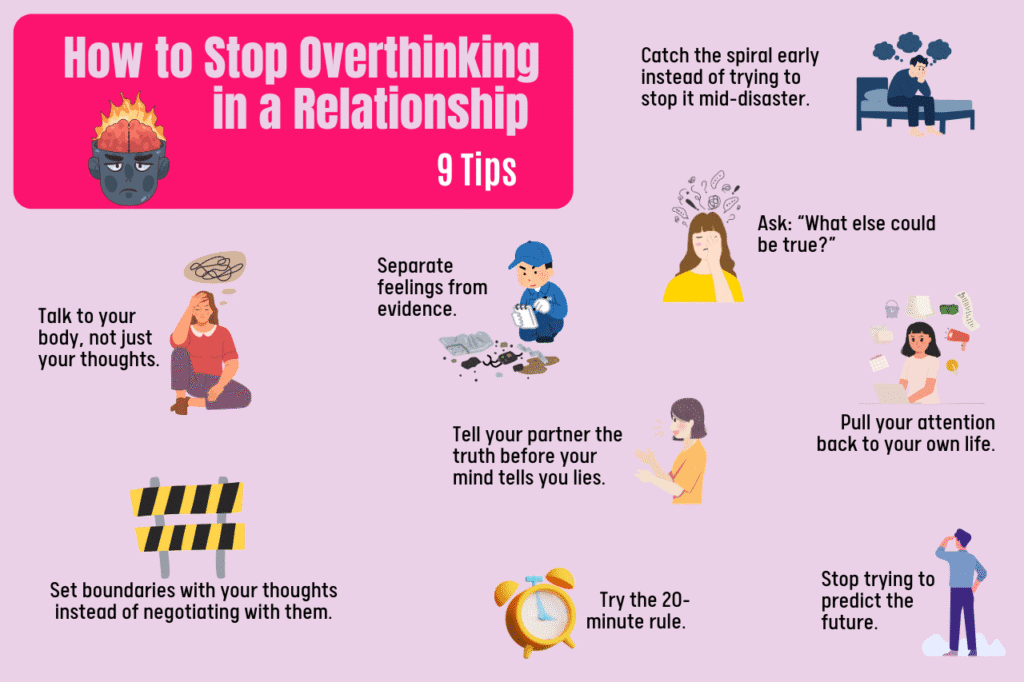
So no, you’re not being dramatic. Your brain is trying to protect you, just not in a helpful way. Here’s how to stop overthinking in a relationship and interrupt the spiral before it takes over:
1. Catch the spiral early instead of trying to stop it mid-disaster.
The earlier you notice the first worried thought, the easier it is to interrupt it. Waiting until you’re 47 screenshots deep only makes things harder.
2. Ask: “What else could be true?”
Your mind offers the worst explanation first because fear gets the front seat. But you can train yourself to list other possibilities. He’s quiet because he’s tired. She didn’t reply because she’s in a meeting. Your brain hates this exercise. Do it anyway.
3. Talk to your body, not just your thoughts.
Overthinking isn’t just mental. Your chest tightens, your stomach drops, your breathing changes. Regulate your body and your mind follows. Slow breathing, a walk, a shower. It sounds basic, but it works.
4. Separate feelings from evidence.
Feeling insecure doesn’t mean anything bad is happening. Feeling uneasy doesn’t mean the relationship is collapsing. Treat feelings like weather: real, but temporary.
5. Set boundaries with your thoughts instead of negotiating with them.
You don’t have to debate every fear. You’re allowed to say, “Not now,” and come back when you’re calm.
6. Tell your partner the truth before your mind tells you lies.
Not every thought needs to be shared, but hiding everything makes the fear grow claws. A gentle “Hey, sometimes I spiral a bit, so if I ask weird questions, I’m working on it,” goes a long way.
7. Pull your attention back to your own life.
Focus on your routines, your hobbies, your friendships. Your partner is not your entire ecosystem.
8. Stop trying to predict the future.
Overthinking is usually an attempt to control what hasn’t happened yet. Let the present be enough for now.
9. Try the 20-minute rule.
When you feel the urge to ask for reassurance or accuse your partner of something vague, wait twenty minutes. Distract yourself. Do dishes. Do pushups.
Usually, the chemical spike of anxiety fades, and you realize you were about to start a fight over literally nothing.
The goal here isn’t to become a robot with no feelings. The goal is to become the confident CEO of your own mind, auditing the frantic reports from your anxiety department instead of letting them run the whole company.
How to Apologize for Overthinking in a Relationship
So, the dust has settled. You freaked out. You accused them of checking out mentally because they didn’t want to hold hands while driving in heavy traffic.
Now that your pulse is back to normal, you feel that heavy, hot shame in your chest. You know you messed up.
The instinct is to grovel. To say, “I am so stupid, I am the worst, please don’t hate me.” Stop that. Right now. That isn’t an apology; that is a demand for them to comfort you.
When you self-flagellate, you force your partner to say, “No, you aren’t stupid, it’s okay.” Suddenly, they are comforting you for an argument you started. That is exhausting for them.
So how do you do it right?
By taking ownership, not pitying yourself. By admitting that your internal weather report was wrong and you accidentally rained on their parade.
Here is how to apologize for overthinking in a relationship without losing your dignity:
- Own the projection. Be specific. Don’t just say “sorry I was weird.” Say, “I realized I was projecting my own insecurity onto you earlier. That wasn’t fair.”
- State the story, not the fact. Acknowledge that the issue was in your head. “I was telling myself a story that you were distant, and I reacted to that instead of reacting to reality.”
- The “Clean Slate” offer. Ask them what they need to move on. “I know that was draining. Do you need some space for a bit, or are we good?”
- Don’t repeat the spiral. The best apology is changed behavior. If you say sorry and then do the exact same thing two hours later, your “sorry” doesn’t matter.
If you want to stop overthinking in a relationship, you have to stop rewarding the behavior. When you apologize correctly, you acknowledge the reality: I felt fear, but I acted poorly. It separates the feeling from the action. It reminds you that while your feelings are valid, your behavior is your responsibility.
How to Stop Overthinking in a Long Distance Relationship
If a standard relationship is a hiking trail, a long-distance relationship is climbing Everest without oxygen. It is hard mode. It is the final boss level for anyone with anxiety.
In a normal setup, you can just look at them. You can see they are tired. You can hold their hand.
In long distance, you don’t have that luxury. You have gaps. Huge, gaping holes of silence and distance.
And your brain? It hates a vacuum.
It rushes to fill those empty spaces with your worst nightmares. They aren’t replying because they are out with someone else. They sounded short on the phone because they are losing interest.
Learning how to stop overthinking in a long distance relationship is basically an exercise in discipline. You are fighting the urge to connect dots that don’t exist. The screen is not their face. The text bubble is not their voice.
So, how do you survive the distance without losing your mind? Here are a few tips:
1. Stop being a digital detective.
WhatsApp says they were “online” 5 minutes ago, but they haven’t texted you back. So what?
Maybe they opened the app to check a work message. Maybe they left the app open in their pocket.
Tracking their online status is self-torture. It gives you data without context. Stop doing it.
2. Schedule the serious stuff.
Anxiety loves ambiguity. If you don’t know when you are going to talk next, you will spend all day worrying about it.
Set a time. “Call at 8 PM.” Now you don’t have to wonder. You can go about your day.
3. Get a hobby that isn't them.
If your entire evening revolves around waiting for a WhatsApp call, you are putting way too much pressure on that call.
You need to be a whole person. Go to the gym. Read a book. Paint something terrible. When you have a life, you have less time to obsess over theirs.
4. Focus on the reunion.
When the spiral starts, shift your focus to the concrete plan. When is the next time you see them? Focus on that date. It is real. The monsters in your head are not.
Ultimately, figuring out how to stop overthinking in a relationship when you are thousands of miles apart comes down to trust. Not just trusting them, but trusting yourself to handle it if things do go wrong.
If you are constantly checking up on them, that isn’t love. It is surveillance. And surveillance is exhausting for the guard and the prisoner.
How to Stop Overthinking in a Relationship After Cheating
Okay, your brain isn’t making things up this time. The tiger was real. It came out of the bushes and bit you.
So, when you find yourself checking their phone or panicking because they came home thirty minutes late, it’s not just “insecurity.” It is a trauma response.
Your body is screaming at you to never let your guard down again.
But here is the brutal truth: You cannot police someone into loyalty.
You can check their location. You can read their DMs. You can make them Facetime you every hour. It won’t matter.
If someone wants to cheat, they will find a way. All that surveillance does is turn you into a prison warden in your own romance. And that’s not a relationship, it’s a hostage negotiation.
If you have decided to stay and work it out, learning how to stop overthinking in a relationship after cheating is about accepting risk.
It is the hardest thing you will ever do. You have to look at the person who hurt you and say, “I am going to give you the knife back, and I am going to trust you not to cut me again.”
Here is how to navigate this minefield:
1. Burn the old relationship.
Stop trying to get back to “how things were.” That relationship is dead. It died the moment they cheated.
You are building a new relationship with the same person. It needs new rules, new transparency, and new boundaries.
2. Stop "pain shopping."
You think you want to know every detail. Where did they touch? What did they say? Was she prettier than me?
You don’t need to know. That isn’t information. That is self-harm.
Ask what you need to know to rebuild trust, not what you need to know to torture yourself.
3. The "trigger" timeout.
When a trigger hits; maybe a song comes on, or they mention a certain place, tell them. “I am feeling triggered right now. I need reassurance.”
Don’t accuse them. Just state the feeling. Let them step up and comfort you.
If they get defensive, well, that tells you everything you need to know about their remorse.
4. Accept that uncertainty is the price of admission.
You will never be 100% sure again. That is the scar. You have to decide if the person is worth the scar. If they are, you have to choose to trust, even when your hands are shaking.
How to Stop Overthinking About a Girl or Boy
You met someone. They are cool. They have great hair and listen to the same obscure indie band as you.
And suddenly, your brain has completely left the building. You aren’t just dating them; you are studying them for a PhD.
You replay the date. Did I talk too much? Did they laugh at my joke because it was funny or out of pity? Why haven’t they watched my Instagram story yet?
You are treating this person like a celebrity and yourself like a lucky fan who won a backstage pass. Stop it.
The problem isn’t them. The problem is that you have forgotten that you are the prize, too.
Your brain acts like you’re walking around with emotional glass in your hands. You’re terrified of dropping it. So you think more, feel more, analyze more.
If you’re stuck there, wondering how to stop overthinking about a girl or boy, here are some steps that could help:
1. Take them off the pedestal.
They are not a god. They have morning breath. They probably have annoying habits you haven’t noticed yet because you are too busy staring into their eyes.
They are just a person. Stop auditioning for a role in their life and start seeing if they fit into yours.
2. The "match energy" rule.
If they send you a three-word text, do not send back a novel. If they take four hours to reply, do not reply in four seconds. Maintain your dignity. Overthinking happens when you are investing way more than they are.
3. Kill the "the one" myth.
Part of the panic comes from thinking, “If I mess this up, I will be alone forever.” That is statistically impossible. There are billions of people.
Scarcity mindset breeds anxiety. Abundance mindset breeds chill.
4. Get busy.
Seriously. Have things to do that are more important than a text message. That’s how to stop overthinking in a relationship.
If you are staring at your phone, it means you aren’t working on your goals, your fitness, or your friendships. Go do something that makes you interesting.
Over to You
Here’s what I want you to take away from all of this: how to stop overthinking in a relationship isn’t about becoming a different person.
And it’s not about suppressing your thoughts or pretending you don’t care. It’s about understanding why your brain does what it does and then gently, persistently teaching it a new way.
Your overthinking isn’t a character flaw. It’s your nervous system doing what it learned to do; trying to keep you safe. The problem is that it’s using outdated software.
So you update it. You notice the spirals. You interrupt them. You build trust, both in your partner and in yourself.
You communicate clearly instead of reading minds. You get a life outside the relationship. You teach your nervous system that connection doesn’t require constant vigilance.
I’d also recommend checking this How to Stop Overthinking in a Relationship book. It goes deeper into these concepts and gives you actual tools to practice.
The truth is this: you’re capable of having a relationship where you’re present, where you trust, where you’re not constantly in your head analyzing everything. It’s possible. It just requires you to do the work.
And you’re already doing it by reading this. By recognizing the pattern. By being willing to change.
That’s where it starts.